
Articles
Here is where you’ll find all the latest print features from our contributors. If you’d like to browse specifically by grade level, topic, or contributor, you can use the links in the right sidebar.
Latest Content
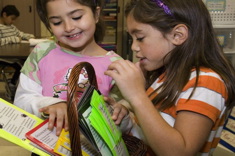
Books that Invite Students into Poetry Writing
Are your students stuck on writing poems that rhyme? Franki Sibberson shares some of her favorite mentor texts for lifting the quality of student poems.
Tips from Literacy Leaders for Closing Out the School Year (ROUND-UP)
Here are some suggestions from Choice Literacy Contributors of the best ways to close out the year, with everything from personal organizing tips to family events.
Best Practices All Day Long: Balancing Personal and Professional Success
If you’ve ever experienced that disequilibrium of feeling completely organized in your professional life, and hopelessly scattered during your personal time, you’ll enjoy Melanie Quinn’s reflective essay.
Transitioning to Guide on the Side: Facilitating Collaborative Scoring
Heather Rader wants to transition to more of a guide-on-the-side role as she coaches colleagues. Here are some simple strategies she uses to move offstage during collaborative scoring workshops.
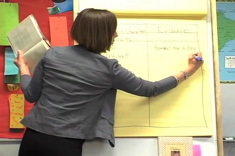
A Closer Look at Anchor Charts
Shari Frost has a gift for helping us think about purpose and this article is no exception as she turns her attention to the benefits of intentional anchor charts.
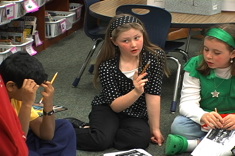
A More Literate Show and Tell
Tammy Mulligan and Clare Landrigan work with a kindergarten teacher to integrate literacy skill development into this favorite routine of young children.
Patrick Allen on Conferring (PODCAST)
Patrick Allen talks about the value of conferring, and what he does to build his conferring skills.

Spring Slump
Audrey Alexander takes a close look at a couple of the students in her self-contained resource room, and finds the observations renew her flagging energy.

Off the Beaten Professional Development Path: What I Learned from the Teachers as Writers Group
Teacher writing groups are a wonderful informal way for teachers to get together over the summer voluntarily. Heather Rader has format suggestions, as well as tips for helping your group run smoothly.
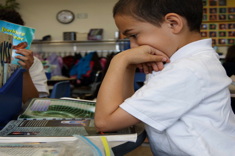
Nonfiction Favorites for Boys (BOOKLIST)
What boy can resist a book titled How They Croaked? If you're looking for some books to fascinate and delight the boys in your classroom, Tony Keefer has some terrific suggestions of recent nonfiction titles in this booklist.

The Power of Checklists in Primary Literacy Workshops
Knowing our most sophisticated professions use checklists to get it right, Clare Landrigan and Tammy Mulligan share and explain checklists that work well for students.

Lesson Structure: Building a Strong Foundation
Stepping back to think about the design of quality instruction is essential for any teacher. Heather Rader looks to brain research and tried-and-true practices to lay out lesson components.
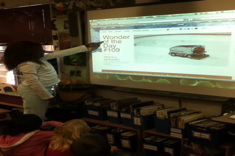
Wonderopolis: Nonfiction, Technology, and Web-Based Independent Learning
Wonderopolis hits the sweet spot so many of us are looking for in web resources for students, delivering free, engaging, high-quality nonfiction text and video in small chunks that can easily be integrated into literacy and science workshops. Andrea Smith explains how she uses Wonderopolis daily with her students.

Making Connections as a Reader and a Scientist
Heather Rader finds that reading is at the heart of scientists’ work.

Pencil Plans
The care and use of the lowly pencil in classrooms says a lot about what we value and our relationships with students.
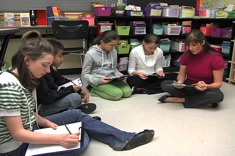
Linking Reading, Writing, and Getting to Know You Activities During the First Week of Middle School
Want to get your middle school students’ attention on the first day of school? Read a book about how to ruin it for them.

Calendaring a Literacy Coach
The joy and challenge of literacy coaching is creating a good structure for the day. Heather Rader has suggestions for short- and long-term planning on the coaching calendar.
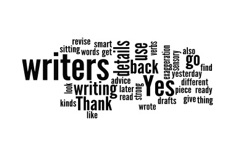
Language Patterns: Reflecting with Transcripts and Wordle
If you are familiar with Wordle, you already know it is a great free tool on the web for creating “word clouds” – visual representations of language. Heather Rader uses Wordle in her literacy coaching to give new and veteran teachers a succinct and powerful visual representation of their teaching language.
Characters I Know Too Well
Books with themes of sexual abuse may be the most difficult for many of us to grapple with, if only because the issue horrifies us. Yet for some abused teens, a book may be the needed catalyst for breaking their silence about what's going on outside school. Andie Cunningham shares an annotated booklist on this tough topic.

Relentless Consistency: Finding a Common Teaching Language Without Scripts
Sharing a common teaching vision begins with a common language, but not a script. Clare Landrigan and Tammy Mulligan share how teachers can work together to develop consistent ways of talking about literacy learning.
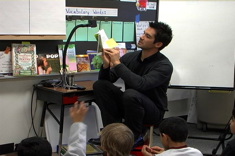
Read Alouds for the First Day of School
Choice Literacy readers share their favorite read alouds for the start of the year.

Injecting Writing into Everything: Cover-up Stories
Cover-up stories involve removing illustrations to heighten awareness of other story elements. Heather Rader explains how the instructional technique works.

The Email Mirror and Literacy Coaching
Are you a minimalist when it comes to email, or do you tend to send rambling and reflective posts? No matter your email style, it likely is a match for some of your colleagues, and a barrier to communication for others.
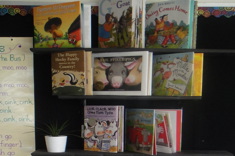
Save the Picture Books!
Are picture books endangered species? Sales are plummeting, in part because parents and teachers are pushing students into chapter books at ever-younger ages. Shari Frost turns a critical eye on her own practice, and brainstorms practical ways to promote the value of picture books in classrooms.

Social Justice Picture Books
If you’re looking for a read aloud to spark some discussions about making a difference in the world, you might enjoy Ruth Shagoury’s new booklist of children’s literature with a social justice theme.
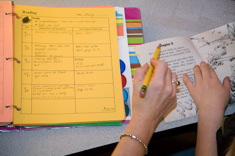
Balancing Assessments Through Better Classroom Notes
Clare Landrigan and Tammy Mulligan explain how literacy coaches can validate and support teachers by helping them refine their classroom notetaking skills.

Ways to Avoid Coaching Traps
There are many traps for new literacy coaches that are rarely discussed. Clare Landrigan and Tammy Mulligan share the most common four they try to avoid.
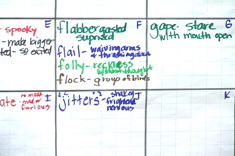
Similes, Metaphors, Homophones and Synonyms: Children’s Books to Teach the Language of Words
Here are some delightful picture books to teach how similes, metaphors, homophones and synonyms work.

Favorite Spaces (Part 1)
What's your favorite literacy spot this year in your classroom? We asked our friends and contributors at Choice Literacy to send in pictures with brief descriptions for this two-part feature. Here is a peek in the classrooms of Donalyn Miller, Julie Johnson, Mary Lee Hahn, Katie DiCesare, and Mandy Robek.

Quick and Thorough: Literacy Coach Conferring Notes
Jennifer Jones finds in a time of budget cuts it is more important than ever for literacy coaches to keep good records of how they spend their time with teachers. She shares a very simple spreadsheet system which includes content codes and brief notes.
Browse Content By
Type
Category
- Assessment Tools
- Big Fresh Archives
- Booklists
- Choice Numeracy
- Classroom Design
- Common Core
- Community Building
- Conferring
- Content Literacy
- Digital Literacy
- English Language Learners
- Equity
- Family Relations
- Free Samples
- Guiding Groups
- Leadership
- Literacy Coaches
- Mentor Texts
- Minilessons
- New Teacher Mentors
- Podcasts
- Poetry
- Quote Collections
- Reading Strategies
- Self Care
- Struggling and Striving Learners
- Talking and Listening
- Teacher Study Groups
- Teaching Reading
- Teaching Writing
- Word Study and Vocabulary
Author
- Melissa Quimby
- Nawal Qarooni
- Gwen Blumberg
- Julie Cox
- The Lead Learners
- Hannah Tills
- Josie Stewart
- Ruth Metcalfe
- Mallory Messenger
- Becca Burk
- Jodie Bailey
- Vivian Chen
- Mary Brower
- Tiffany Abbott Fuller
- Stephanie Affinito
- Ruth Ayres
- Leigh Anne Eck
- Heather Fisher
- Shari Frost
- Julie Johnson
- Suzy Kaback
- Gigi McAllister
- Shirl McPhillips
- Melanie Meehan
- Cathy Mere
- Debbie Miller
- Tara Barnett and Kate Mills
- Tammy Mulligan
- Dana Murphy
- Bitsy Parks
- David Pittman
- Brenda Power
- Heather Rader
- Matt Renwick
- Mandy Robek
- Christy Rush-Levine
- Gretchen Schroeder
- Jen Schwanke
- Brian Sepe
- Katherine Sokolowski
- Stella Villalba
- Jennifer Vincent
Grade Level
Choice Literacy Membership
Articles
Get full access to all Choice Literacy article content
Videos
Get full access to all Choice Literacy video content
Courses
Access Choice Literacy course curriculum and training
