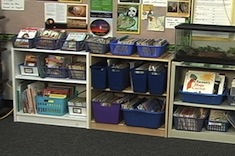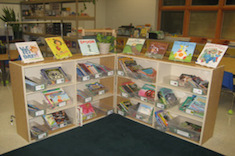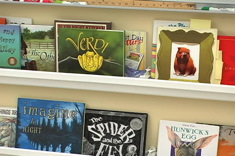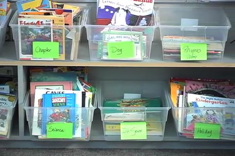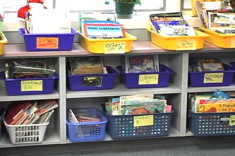
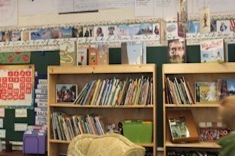
When entering my classroom, you immediately notice one thing: books. The classroom library now houses more than 3,000 titles. In more than 14 years of teaching, I have amassed quite a collection. Garage sales, book orders, donations, and my own wallet have all contributed titles that now line these shelves. Over the years, the library organization has changed regularly. I watch my students, learn what works and what doesn’t, and move on from there. Gone are the days that the books were just placed randomly on our shelves. Now there is thought, purpose, and a system in place. This doesn’t, however, mean I can sit back and relax. Each year I improve it just a bit, rethink the way we use it, and retool for the year to come. After talking to my students, we came up with three problem areas in our classroom this year: picture books, nonfiction, and series books. Let’s look at one area at a time.
Picture Books
Picture books have always been an area of struggle for me. When I began teaching fifth grade, I didn’t have many. As I’ve moved to a workshop model, this is the area of the library that has grown the most. Picture books are the perfect length of text for a minilesson, and my collection has grown from 30 to more than 400. At that number, it no longer works to place these books on a shelf; I need to be able to find them when needed, as do my students. Last year I tried bins where they were sorted by genre on our shelves. Although this made it easier to find them, my students struggled to flip through the bins and put the books back without tearing the covers.
When thinking about how to solve these problems—torn covers, difficulty selecting out of the bins—I remembered the record stores I visited as a child. Picture books are roughly comparable to a record in size, and their bins were open on top so that you could easily flip through them. I decided that I needed a similar storage spot in our classroom.

Now our picture books will be housed on the top of our shelves, about waist height, around the classroom. I have purchased bins so that I can sort the books by genre and easily grab some for minilessons.
Nonfiction
Several years ago I realized that the nonfiction section of my library was limited to biographies and books similar to the Guinness Book of World Records. I immediately began purchasing a wider variety of books for our collection. When the size increased, I made the decision to organize it by the Dewey Decimal System. My thinking was that if a student was reading a book on mythology and wanted more than we had in our classroom, they could look at the sticker to see that it was in the 200s in our school library and head there to select more books. Although this has helped a bit with browsing, it still is a struggle for kids to find books they want in our classroom. My biggest concern about the nonfiction portion of the library is that kids do not check out nearly the number of books they check out from the fiction portion.
Reflecting on this at the end of the.jpg) school year, I asked my students why this was. Answers ranged from not knowing what we had to not knowing where to find a topic. After listening to Franki Sibberson present this summer, I realized another important problem: in my fiction section of the library, I have books organized by series and author. This doesn’t happen in my nonfiction section. That needs to change.
school year, I asked my students why this was. Answers ranged from not knowing what we had to not knowing where to find a topic. After listening to Franki Sibberson present this summer, I realized another important problem: in my fiction section of the library, I have books organized by series and author. This doesn’t happen in my nonfiction section. That needs to change.
So for next year, the Dewey Decimal stickers will remain for their original purpose: to show them where to find more books like these in the school library. The organization of baskets will move to baskets by author, topic, and series—just like my fiction books. I think this will help my students find more books they want to read in our nonfiction section of the classroom.
Series Books
By far the biggest issue we had with books this year was placement of series books. Years ago I moved to storing books in baskets, which made it so much easier to find a book than when I had them sitting spine-out on the shelves. The exception would be books in a series. I do have a few baskets for a few series in our room, but many are stored in tubs according to genre. This became a bit of a struggle this year as students attempted to find more books in a particular series.
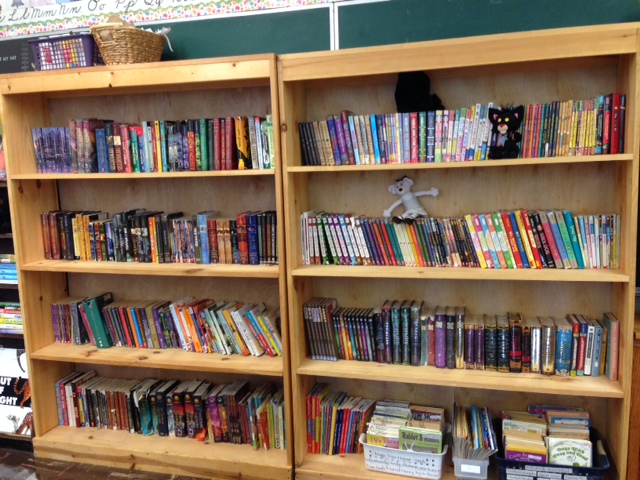 Walking into our fiction section, you will notice 10 tubs labeled “Fantasy” and the same number for realistic fiction. Although fans of these genres can easily find the books they love to read, they struggle to find the next book in a series, often having to pull out all of the tubs and flip through them to find the next book. There were many times this year that I would look up during a reading conference to notice baskets all over a table with several kids trying to find Insurgent, Sent, This World We Live In, or another series book for a friend. At the end of the year my student Delaney said to me, “You know, it would be easier if these books were just facing out on a shelf.”
Fifth graders are big fans of reading books in a series, so I need to make it a bit easier to find these books. Taking Delaney’s idea, we’re going to commandeer the tall shelf when you walk into our classroom and fill it up with books in a series. At the start of the year, when teaching how we use our classroom library, we will need to have conversations about putting books back where we find them, which will be a bit more difficult since the books won’t be in baskets. I think the ease of finding Book 2—or 10—in the series you are reading will outweigh that negative.
Revisiting how your classroom library worked for you and your students at the end of the school year and at the start of a new one is an important reflection. Just as I weed out the books we are no longer reading or that are falling apart, I need to rethink organization practices that we’ve outgrown or improve on practices that aren’t quite working. I look at our library as a living and breathing part of our classroom. We need to prune it back yearly to allow it to flourish.