
Choice Lit Topic: Teaching Writing
Everyone who writes for Choice Literacy loves teaching writing, because we all write ourselves. We know it is “hard fun,” as Donald Murray famously said—exasperating and exhilarating at the same time. The writing workshops you will read about here and see in our videos are busy, noisy, vibrant places. And most days, we wouldn’t want to be anywhere else than in the midst of ’em! Here is where you’ll find our latest discoveries, insights, and occasional boneheaded mistakes in teaching writing.
Results
Sports Writing Group Discussion
As part of our nonfiction writing study, many of the students in the class began to write about sports. Every year that I've taught in any grade, this is a...
Nonfiction Word Hunt Part I
Nonfiction word hunts are a routine that I recently discovered. It immediately had an impact with my students' interest in words and their meanings. Knowing the meanings of words is...

Conferring with Eddie
Eddie is a six-year-old student who speaks Cantonese as his first language. In this conference with Ruth Shagoury, little English is spoken, and yet there is much communication through gestures...
Listing Strategy: Minilesson
Aimee Buckner confers with students after a listing strategy minilesson in writing workshop using the book This Is the Tree.
Crafting Characters in Writer’s Workshop
In this lesson from writer's workshop with grades 3 and 4 students, Franki Sibberson helps students analyze character traits through whole-class and partner work with the lead to The Secret...
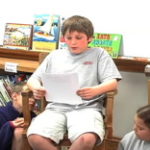
From Compliments to Naming the Craft: Fifth-Grade Writing Workshop Share Session
This whole-class share session in Lesley Fowler's fifth-grade classroom is the culmination of a nonfiction writing unit. Over the course of the year, we moved from having students compliment their...

Conferring with Leonela: A Two-Day Progression
Leonela is a six-year-old student whose first language is Spanish. In these videos of conferences with Ruth Shagoury filmed over two days, she makes connections between her drawing, writing, and...
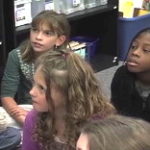
Rule of 3: Writer’s Craft Whole-Class Lesson
The "Rule of 3" is well known among writers. From "The Three Little Bears" to sets of three adjectives in descriptions, authors know clusters of three are a powerful tool...
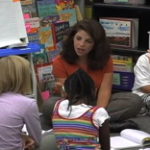
Rule of 3: Mini-Group After Whole-Class Lesson
I often ask students who might want a little more information or help after a whole-class lesson to stay for a small group. These "mini-groups" are an important part of...
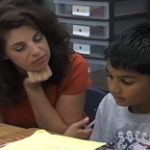
Rule of 3: Conferring
In this final video of a three-part series showing my teaching progression for Rule of 3, I confer with individual students during writing workshop, checking in to see how they...
In the Zone: Conferring with a Young English Language Learner
The Zone of Proximal Development (ZPD) is a concept developed by the Russian language researcher Lev Vygotsky nearly a century ago. The theory simply stated is there is a learning...

Two-Column Notes (E-GUIDE)
It's hard to know who to credit for the incredibly useful two-column note tool. While two-column notes are definitely a kissing cousin to the Cornell Note-Taking System (Pauk, 1974), in...
Fonts Lesson: A Revision Strategy for Transitional Writers
I recently added a nonfiction reading time at the start of the day, and I've found this time has changed many of the conversations about reading and writing with the...
Conferring in the Zone: Vygotsky’s Zone of Proximal Development and Writing Conferences
The Zone of Proximal Development (ZPD) is a concept developed by the Russian language researcher Lev Vygotsky nearly a century ago. The theory simply stated is there is a learning...
Fonts: Small Group and Conferring with Intermediate Writers
In this follow-up to a whole class lesson and discussion on fonts, Franki Sibberson pulls together a group of third and fourth graders from her class who have asked to...
Designing Comprehension Constructors: Helping Adolescent Learners Develop Reading Strategies (E-GUIDE)
Comprehension instruction has value and lasting impact when teachers know how to design lessons, activities, and materials that match the needs of their students. Prefab worksheets or generic activities and...
Writing Conference Principles
When we were first learning to confer with students of all ages, we devoured books written by Nancie Atwell, Donald Graves, and Lucy Calkins. Each of these teachers had their...
The “All About Us” Board: Linking Literacy and Community Building All Year Long
One activity that supports our community building and literacy development all year is the "All About Us" bulletin board. In preparation I divide my largest bulletin board into as many...

Understanding the “Silent Period” with English Language Learners
If you have a new English language learner in your class who is not speaking, don't worry. According to language researcher Stephen Krashen, most new learners of English will go...
The Read-Around: Raising Writers
The read-around is the classroom equivalent to quilt making or barn raising. It is the public space -- the zocolo or town square -- of my room. During our read-arounds,...
The Art of Listening in Writing Conferences with English Language Learners
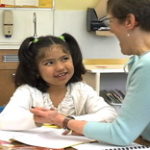
Listening looks easy, but it is not simple. Every head is a world. —Cuban proverb Researchers have studied the physiology of listening and speaking. One of the things they discovered...
