
Choice Lit Topic: Teaching Writing
Everyone who writes for Choice Literacy loves teaching writing, because we all write ourselves. We know it is “hard fun,” as Donald Murray famously said—exasperating and exhilarating at the same time. The writing workshops you will read about here and see in our videos are busy, noisy, vibrant places. And most days, we wouldn’t want to be anywhere else than in the midst of ’em! Here is where you’ll find our latest discoveries, insights, and occasional boneheaded mistakes in teaching writing.
Results
Scaring Up Better Narratives Part 3
Aimee Buckner leads a lesson on brainstorming topics in writer's notebooks using the mentor text Some Things Are Scary. In this final installment, Aimee continues to confer with students and shares a great tip for nonfiction research.

Conferring with Vita: Working Through Silence
Andie Cunningham confers with Vita, an English language learner whose first language is Russian. Vita is in the silent period. Notice how Andie coaxes communication from Vita, and manages to...
Listen In: XBox Game Writing
Heather confers with Cody about his gaming story. He starts off the conference by reading aloud an excerpt of his writing. Heather responds to it personally as well as compliments his growing awareness of audience. She then uses a mentor text “Shortstop from Tokyo” by Matt Christopher to show him how long and short sentences can be used to make active writing engaging. She ends with an invitation to play with this concept in his writing.
Listen In: About the Author
Snowy owls. Polar bears. Arctic hares. These fine white creatures were all the rage in second grade during their literary nonfiction unit. Linda Karamatic and I co-planned the new writing...
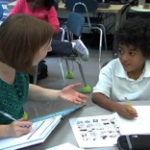
Conferring: Stretching Words
Beth Lawson works with an English language learner writing his first sentence, School is over. Using tools of an alphabet chart and the strategy of stretching it out, this student works through the sentence with Beth's support.
Listen In: Writing Reviews
At first glance of Kincaid's writing folder, I saw rows and columns of data. Next to a book title was a number and then a line of letters and numbers,...

Drawing to Learn: Conferring with Luis
In this four-minute video, Andie Cunningham confers with Luis during writing workshop. Luis is a six-year-old English language learner whose passion is drawing.
Fonts: Small Group and Conferring with Intermediate Writers
In this follow-up to a whole class lesson and discussion of fonts, Franki Sibberson pulls together a group of 3rd and 4th graders from her class who have asked to be a part of a small group on fonts.

Reading Word Problems: Test-Taking Skills (Part 1)
Andrea Smith leads her 4th grade class during word study time as they analyze a math word problem. She uses an anchor chart developed by the class that lists math skills and strategies that are essential for success.

Conferring with Vita
Andie Cunningham confers with Vita, an English language learner whose first language is Russian. Vita is in the silent period. Notice how Andie coaxes communication from Vita, and manages to convey a sense of delight at her work, an acknowledgment of Vita's importance in the classroom community, and some guidance for future writing.

Conferring with Eddie
Eddie is a six-year-old student who speaks Cantonese as his first language. In this conference with Ruth Shagoury, there is little English spoken, and yet there is much communication through gestures and shared history.
Conferring with Emily
In this conference with six-year-old Emily, Ruth Shagoury looks for a way into a conversation by using Emily's drawings, previous writing, and interests. Emily's first language is Hmong, and she is experimenting with Chinese characters in her writing.

Conferring with Anna
Anna is a five-year-old student in an Oregon kindergarten classroom who speaks Vietnamese at home. In this conference with Ruth Shagoury, she shares writing about her classmates and a snake, testing out her growing knowledge of the alphabet, sounds, and the purposes of writing.
Fonts Lesson: A Revision Strategy for Transitional Writers
Franki Sibberson teaches a minilesson on fonts as a revision strategy for her grades 3 and 4 students.
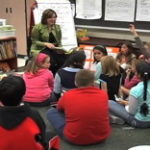
Crafting Characters in Writer’s Workshop
In this lesson from writer's workshop, Franki Sibberson shows how shared text can be used to help young writers understand character traits and development.

Revising Titles Minilesson
In this minilesson from Franki Sibberson's grades 3 and 4 classroom, Franki takes students through the process of selecting and revising titles. For young students having trouble understanding that writing revision involves more than just adding text, a minilesson on revising titles is a quick and easy way to show the power of making small changes to drafts.

Quick Take: “The Sisters” on Writing Journals
In this two-minute Quick Take video, Gail Boushey and Joan Moser ("The Sisters") talk about the importance of having "Small Moments" and "Happenings" sections in student writing journals. They have...
Extreme Makeover: Revision Edition
Once upon a time in my third-grade classroom, I had an eight-foot pencil poster on my wall that listed the steps of the writing process from prewriting at the point...

Sixth-Grade Lesson: Editing for Conventions
In this lesson with her sixth graders, Pam Pogson talks about a goal many students have mentioned during writing conferences: editing for conventions. This brief lesson gives everyone a chance...

The Five-Minute Solution: Mini-Groups after Minilessons to Maximize Conferring Time
Writing conferences in the upper elementary grades can be scary. Books and gurus say you have to have "editing conferences" and "revision conferences" and "idea conferences." They say you need...
Over the Top: Mystery Writing with Fourth Graders
Helping students navigate the boundaries between realistic fiction and fantasy can be tricky, especially when it comes to mystery writing. In this lesson from Beth Lawson's fourth-grade classroom, Beth uses...
