
I recently worked with some incredibly thoughtful fifth-grade teachers who were studying their reading instruction. They knew they wanted students to have more time to read, and, more specifically, read books of choice. But where would they find the time when their curriculum required so much “modeling” and “guided practice”? Maybe a lesson from your curriculum sounds similar to theirs:
Insert text passage…
- about a topic kids may or may not be interested in;
- about a topic that may or may not be relevant to or represent kids’ lived experiences;
- that may or may not be at an accessible reading level for students.
Teacher models: “This sentence here is important, so I’m going to highlight it. It’s a key detail. Let’s read the next paragraph. This is another key detail, so I’m going to highlight it.” Rinse and repeat for the next two or three paragraphs, whichever comes before you really lose the class.
Teacher guides: “Now you read the next two paragraphs. Make sure you highlight the key details as you read.”
The teacher’s guide says this should all take about 10 minutes; in reality it takes closer to 30 minutes or more. Add in the 30-plus minutes it takes to fill out a premade graphic organizer and you’ve used up an hour of instruction. That might be a bit of an exaggeration, but probably not by much. And was that hour meaningful to all of your students?
I asked the group of fifth-grade teachers to think about their own students. Who was thriving with these lessons? Who was surviving? Who was hanging off the cliff? Then we listed the characteristics of the students who were thriving:
Advanced-level readers
People pleasers
Kids who need a lot of structure
Most teachers said that a handful of or fewer students in their class fell into that category.
What about the kids who were surviving? No one really fell into that category. That left the kids hanging off the cliff.
All the other fifth graders
Phew! All that time on just one lesson and it was serving only a small fraction of the class. So what to do when you’re not allowed to chuck the textbook altogether?
Let’s shrink the lessons and reclaim our time!
-
Determine what skill or strategy the lesson is trying to teach.
Most of the time this is explicitly named in the teacher’s guide. For example, in the scenario above, kids are supposed to be learning how to determine the main idea and key details of a text.
-
Make the invisible visible.
What’s usually missing in many reading curriculum guides is how to do the skill. Again, look at the scenario above; kids are left to infer how the teacher decided to highlight a particular sentence. So we need to get metacognitive and spy on ourselves as readers. Try it out with a text from your reading curriculum. What are the moves that you make to determine the main idea and key details in a text?
Do you read a chunk of text and ask yourself what it’s mostly about?
Do you look for repeated words or phrases?
Do you think about the structure of the text to determine the main idea?
-
Make it clear and concise.
When thinking about how to deliver clear and concise instruction, I start with having a clear teaching point. In one of my favorite teaching resources, DIY Literacy, Kate and Maggie describe a common formula to crafting a teaching point. Name the WHAT + HOW + WHY. We already did the first two parts. The last bit is to communicate the purpose of using the skill.
I made my own little cheat sheet for planning. (It works for writing too!)
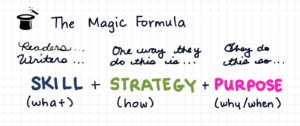
Here’s an example of how that might sound:
Readers determine the main idea of a text. One way they can do this is by paying attention to repeated words and phrases, then asking themselves, What is this text saying about [repeated word or phrase]?
-
Break it down.
Some strategies and some learners might benefit from step-by-step instructions. For the strategy above I might break it down like this:
- Read a chunk of text.
- Notice any repeated words or phrases.
- Ask, “What is this text saying about [word/phrase]?”
- Try out a main idea.
Now you’ve got a clear strategy that you can model and that kids can try out in a fraction of the time it took to go through a text paragraph by paragraph by paragraph by… Rather than slogging through an unengaging, inaccessible text, kids have time to read and try out this work in their own books that they’ve chosen.
One of the most difficult things about this process is letting go of the idea that kids will be perfectly proficient in whatever skill you’re teaching. They won’t be; they’ll need repeated opportunities to practice along with some coaching. But we already know the kids weren’t getting it using the teacher’s guide version either. The difference is that in the first scenario, there might’ve been some comfort in seeing a final product at the end of the lesson that looked like they got it. In truth, many of them completed the product only with a lot of hand-holding.
The next time you’re facing the teacher’s edition, reclaim your time, and make that lesson a whole lot shorter and a whole lot more meaningful for your readers.