

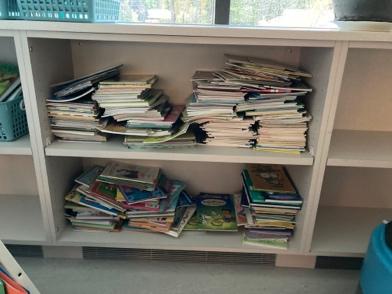
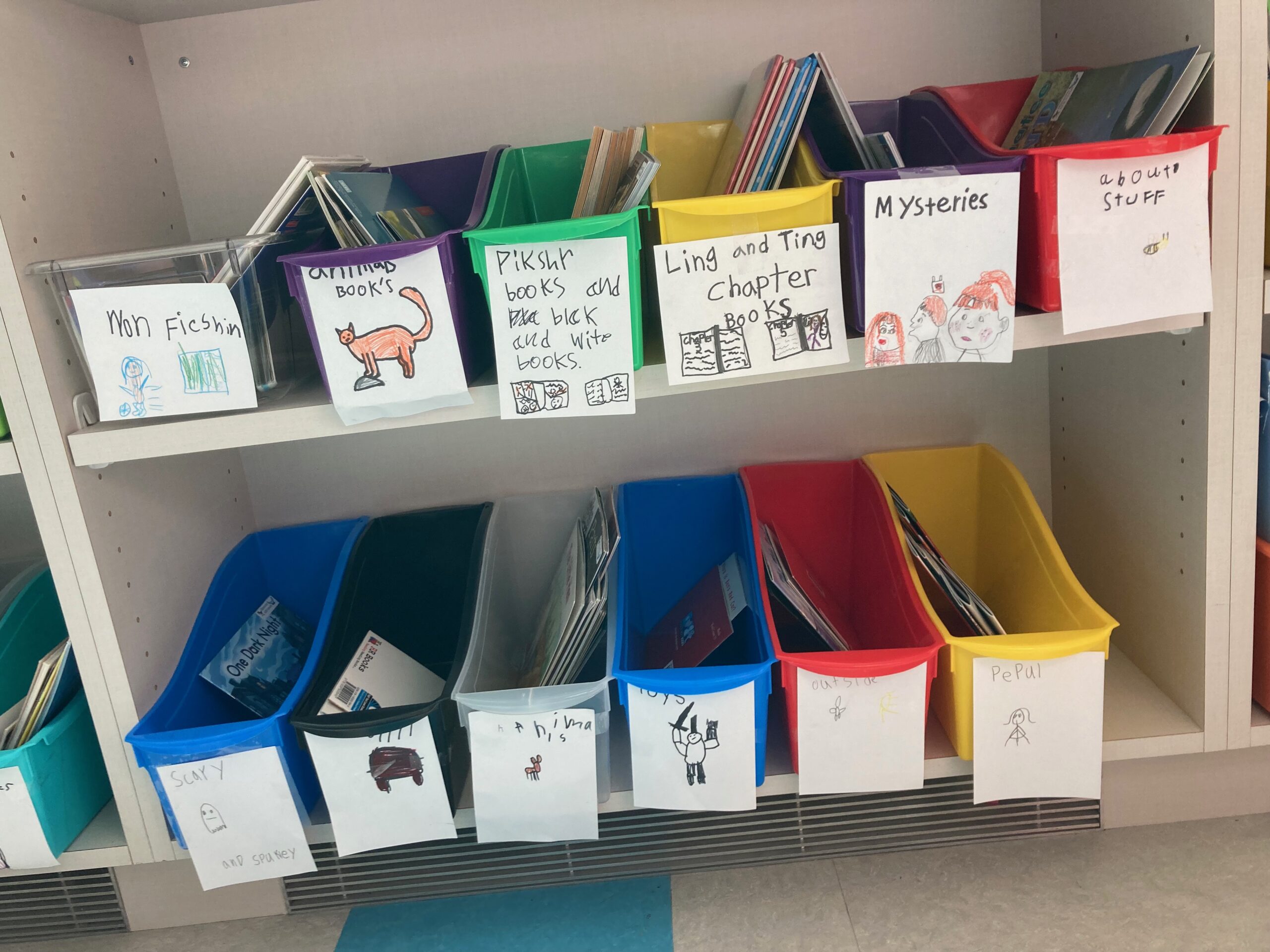
I intentionally started the school year with hundreds of books scattered on a few shelves because I wanted the children to construct the library. And yes, after 10 days in the classroom, the kids did create this library. But these two photos don’t reveal the process behind the scenes. After living through the process of having second graders create most of the classroom library, I think I figured out a few things to make the process manageable, productive, and joyful.
Starting Out
Before the school year began, I sorted the books into a few big categories that would help me launch the year: books that kids would be able to read, wordless books, books I wanted to read aloud, and books that were best for later in the school year. A few labeled baskets are filled with wordless picture books and easy-to-read picture books. The rest of the classroom library is a giant mess of stacks of texts at easy text-complexity levels and easy-to-read series books.
Why Wordless-Book Baskets
Before the school year began, I thought, What message do I want kids to learn about reading right from the start? What is most important? For me, the answer was finding meaning and connection. I wanted kids to understand that readers think as they read and talk with other readers about books. So, I created four baskets of wordless picture books. I raided my collection of books, the school library, and the public library to fill those baskets.
All of these books encourage students to think and to put the images on the pages together to create a story. As students read, they learned how to take turns and ask each other two of the most important questions readers ask: “What are you thinking, and what makes you think that?” And besides, kids love these engaging titles.
At the start of the year, wordless books were our friends. Thanks to Covid, many kids entered school with beginning reading skills. Worse than that, many children had very little access to texts at home. Wordless books helped take some of their reading anxieties away. Whether students were reading independently or in pairs, they were in front of books that helped highlight their ability to think about a text rather than highlighting reading deficits.
To help kids select books, I put the wordless-book baskets out on the rug. Then the children simply selected a book with their partners and went off to read. Once they were done, they put it back and grabbed another. It wasn’t perfect. Yes, some kids rushed through books. But over a few days, we learned how to slow down, look closely, and connect the pages together to reveal a story. The wordless books also helped buy me some time to get to know my readers, so we could build independent book boxes for each student.
Getting to Know Readers
Now that the kids were engaged with texts, I headed out with my pile of benchmark books in hand. I moved from student to student, watching how they interacted with the wordless books: What are they picking up from the text? How are they reading the very few words on the page? Then, one by one, I read a few pages with each child to figure out an approximate independent reading level. No, I didn’t have a perfect sense, but I started to see what range of texts might work. In my classroom the range was wide, but I was able to create four text-complexity categories: students who could successfully read texts at B/C, D-F, and H/I, and J+ readers. With this information, I was ready to get kids to touch the piles of unorganized books in the library.
Dealing with the Piles on the Shelves in the Library
I must be honest right now. The piles of books in the classroom library terrified me during those first few days of school. I had so much to do, and the worry that I was going to have many late nights buried in children’s books was real. But it didn’t happen. I kept telling myself, The kids are going to chip away at the piles. It doesn’t need to be done in one day. Looking back now, I see that this was absolutely true, but in the beginning, I was panicked.
And so, we began . . .
I took a manageable stack off the shelf (probably 100–120 books) and sorted them into four baskets organized by the approximate complexity bands of my students. This process wasn’t perfect either, but within a few moments, I had four baskets with about 20 books in each. Now students had a new reading opportunity during reading workshop. For the first 10–15 minutes of reading, they sat in small groups around the baskets of books that they could read independently.
After they’d read the books for two days, I asked kids to sort the books in front of them into piles. “Readers, we need to build a classroom library together, and our first step is to sort the books in front of you. Look at the books and think, What books go together here? Are there books that are funny, and they should be together? What about books with the same characters? Can you put those together? How about books with cool facts—can they go together?” Then with a pile of empty book bins, and access to a tape dispenser, a stack of index cards, and a pencil, kids created bins and labeled them.
As they worked, kids called out categories—”We could have a people bin, an animal bin, a question-mark bin because we don’t know where to put it. These are all Brownie and Pearl books. Oh wait, what about a scary-book bin?” They even created a clown-book bin.
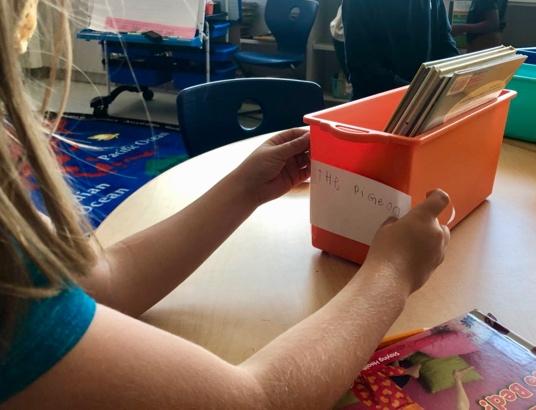
Now, I know what you are thinking, because I was worried about the same thing. Aren’t all four tables creating some of the same book bins? Yes, that did happen, but it worked out just fine. As the children moved the completed book bins to the classroom library shelves, they put like bins together—all the people bins were together, all the animal bins were together, and so on. Kids started to naturally consolidate the books as they saw duplicate tubs on their own.
For a few days, we repeated this process. I filled the four large bins by text complexity, they read quietly, and then they sorted. Little by little the piles of books on the shelf got smaller and smaller, and the labeled book boxes filled up.
We now had a first-draft functioning classroom library. This is what we need in September. As the year progresses, we revise, update, and revise some more. The library changes and grows just like the readers in the classroom.
