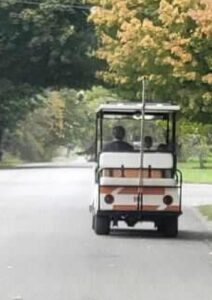

Some of my favorite moments come from the time I spend with family and friends at our seasonal campground—a place where adventure is always just around the bend. It’s my favorite spot to make memories with my grandsons, where we test our bravery, push our limits, and embrace the thrill of the unknown.
Our noble steed for these wild excursions? A 1992, three-row, electric tram that once shuttled eager theme park guests from the parking lot to the grand entrance gates. Now, it proudly sports bold orange-and-white stripes, a well-placed mustache between its headlights, and a disco ball swinging from the roof. A remote-controlled light bar on the back flashes through a rainbow of colors, setting the mood for every ride.
We call it Joe, the Sloppy Jalopy—and for good reason. It huffs and puffs up the campground’s steep, winding roads, leaving us cheering it on like a prizefighter in the final round. Then, just when we think we’ve conquered the climb, we brace ourselves for the thrilling, slightly nerve-racking descent, questioning whether Joe will stop before we do! I’ve lost count of how many times we’ve watched the charge drop from half to nearly nothing in an instant, exchanging nervous glances and wondering if we’ll have to push Joe home before he can be plugged in again.
When we’re not cruising in Joe, we spend hours at the pool, pushing our limits in new ways. We challenge ourselves to touch the very bottom of the deepest part, swim farther without coming up for air, and attempt somersaults off the diving board. But the real test of courage? Night swims—where we dare each other to jump off our floaties and make the eerie swim to the pool’s edge, braving whatever unknown might be lurking beneath us.
It’s always with a heavy heart that we face the last weekend of the season. Everyone gathers for one final s’more, and we all pitch in to button up the lot for the long winter ahead. This year, the boys took their last flights on the swings as the adults were getting ready to load Joe onto the trailer. He was long overdue for some motor updates and—well, maybe some actual brakes.
As I stood there, a thought crossed my mind: The adventures don’t have to stop here!
“Boys!” I called out. “Jump in! We’re taking our adventures on the road!”
Their eyes lit up, but hesitation crept in. “Mamaw, we can’t take Joe on the real road,” one of them said. As my husband gave me that Are you serious? look, he reminded me, quite practically, that it was a long, hilly drive home.
I turned back to the boys with a grin. “Well, you in?”
They didn’t need to be asked twice. They came running full speed and jumped aboard like we were setting off on a grand expedition.
“You better grab the extension cord in case we don’t make it!” one of them shouted.
“I’m grabbing snacks!” the other called back. “I don’t want to starve if we have to wait for someone to rescue us!”
Taking risks in learning leads to deeper understanding and motivation because it’s driven by curiosity, not just fear of failure.
— Carol Dweck
How often do you hear, “The kids just don’t care” or “They aren’t motivated to do anything”?
Are kids entirely unmotivated, or are they just not motivated by the same things we expect them to be?
Carol Dweck’s research on growth mindset emphasizes that when children approach challenges with the belief that they can improve and grow, they are more likely to persist through difficulties. Instead of viewing failures as evidence of their limitations, they see them as opportunities for learning. Resilience is built by embracing mistakes, understanding that they’re part of the learning process, and pushing forward even when things don’t go as planned. Children who develop these traits tend to be more successful in the long run because they aren’t discouraged by obstacles. Instead, they use challenges as stepping stones for further development.
By incorporating the following principles, we can create classroom environments where students are encouraged to take risks, reflect on their experiences, and turn fear into bravery. By design, we can help students develop resilience and perseverance, empowering them to tackle obstacles with confidence and a mindset focused on growth.
Freedom to Take Risks
Encouraging students to take risks—whether it’s sharing an idea without knowing if it’s “right,” tackling a challenging project, or trying out a new strategy—gives them a sense of ownership and purpose. Risk-taking shifts the focus from simply meeting expectations to exploring possibilities, which can be a powerful motivator.
“Bravery drafts” encourage students to bring bravery to the writing process. Develop a culture where rough drafts aren’t about perfection but instead are about exploration. Share times you have taken risks in your own writing—the feelings you experienced, the outcome of your risk. Model writing freely without fear of mistakes. Open the door for students to engage in their own “bravery drafts,” and then reflect on their risks—what worked, what they would change, and how it helped them grow as a writer.
Space to Reflect
Giving students time and space to reflect on the emotions, fears, and anxieties they may experience while taking risks allows them to process and overcome those feelings. A classroom environment where students feel safe to discuss these emotions helps them recognize that fear is a normal part of bravery, and it’s an opportunity for growth.
“Huddle up” discussions bring space for reflection in any situation, whether they are math huddles, writing huddles, or reading huddles. After a challenging concept, provide time for students to “huddle up” and discuss their struggles and breakthroughs. Students can share when they felt frustrated and what strategies they tried. This type of reflection normalizes struggle and shows students that learning isn’t about immediate success but about persistence and growth.
Encouragement to Turn Fear into Bravery
When students are encouraged to acknowledge their bravery, even if they didn’t achieve the outcome they hoped for, they build resilience. This fosters a mindset that sees failure not as an end but as part of the learning journey, helping students channel fear into courage for future challenges.
Don’t cast the “stones.” Don’t miss a moment to shift students’ mindsets from fear of being wrong to seeing mistakes as “stepping stones,” for deeper learning. Acknowledge their bravery for raising their hand. Ask, “What can we learn from this?” when students share a wrong answer. Create a space to save these stones—a bulletin board or stone wall where you can write what you have learned from the mistakes. We often “cast away” these small moments to model that making mistakes is how we learn.
In the end, do students need to be forced to care—or do they need opportunities to discover why learning matters to them?
So, I wonder… is learning an adventure full of twists, turns, and bravery in your classroom?
If not, what bold steps can you take to make it one?
Put away the packets and take it on the road…
—I dare you!
If you are not willing to risk the unusual, you will have to settle for the ordinary.
— Jim Rohn
P.S. We did make it home… And we are still telling our story!