

A screenful of children waited eagerly. An educator walked to the front of the room and announced the title of the book that had won their student-selected book award. The room erupted in joyful cheers and applause. A few children jumped up and down, their reactions mirroring those of sports fans observing a winning goal in a championship game. I was intrigued by this video of a book award ceremony and knew I wanted to re-create it with my own students.
The first step of my process was to decide which mock award I wanted to run. Since I would be teaching K–4 students during the time I could devote to a book award unit, I focused on a picture book award. After examining the criteria, mission, and timeline of the various awards, one stood out as the best match for our school community: a Mock Ezra Jack Keats (EJK) Award.
Ezra Jack Keats was one of the first American authors to write stories that featured Black children as the protagonists experiencing everyday activities and adventures. In 2020, the New York Times reported that his book The Snowy Day was the most checked-out book in New York Public Library history, with 485,583 circulations (De León, 2020). The award named in his honor, given by the Ezra Jack Keats Foundation, is focused on story elements important to Keats and to our school community as well—authentic representations of childhood, family, and diversity. The EJK Award highlights newer authors: Nominees must have no more than three published books, and the foundation offers support to educators who want to run a Mock EJK Award to provide a supportive scaffold with lots of room for personalization.
Selecting Books
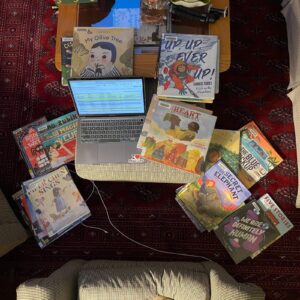
Once I had decided on my mock award, I needed to select the books we would consider. The EJK Foundation provided a list of books for consideration. I requested them all from my public library and ended up with a very large stack. As I read each of them, I kept notes in a spreadsheet and physically sorted and resorted the books into categories as I narrowed down the list to a manageable number.
Timing
I then looked at the time I would have to run the award. I identified a six-week block running from the end of January to the middle of March, when the actual EJK Award would be announced. I determined some of the books were short enough that I could read two books a week, so I thought I could reasonably include 10 books in our award process.
Criteria
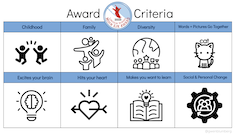
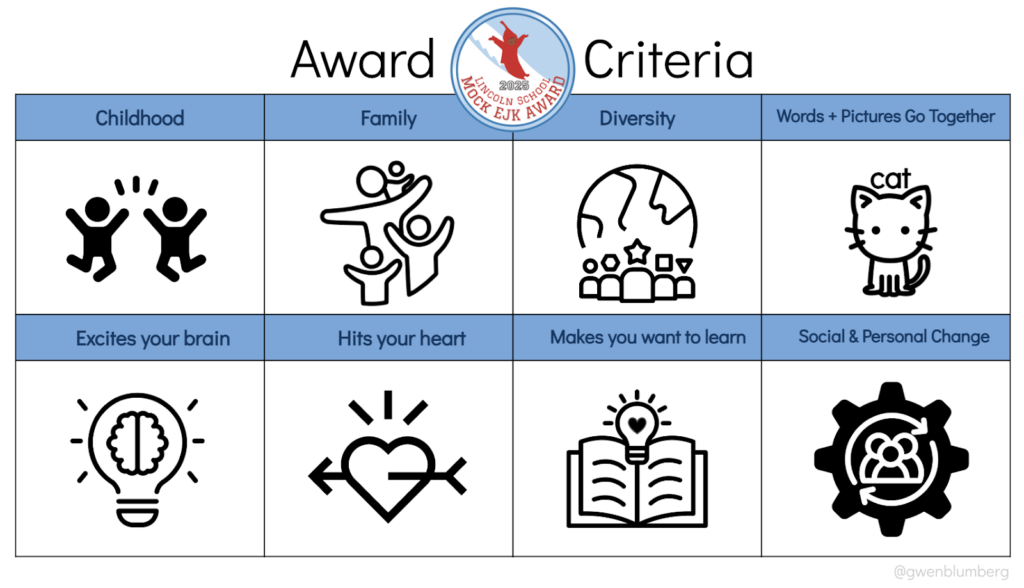
Rather than having kids vote for their preferred choice based solely on likeability, I wanted them to think deeply about how the books met or didn’t meet a set of stated criteria. Using guidelines provided by the EJK Foundation that were solid but very text-heavy, I set out to create a visual representation. Using graphics from The Noun Project, I selected one icon for each criterion. I then thought about brief, kid-friendly language that could be used in the form of questions throughout the book award unit to guide the students through the criteria and make it user-friendly for K–4 students.
Sample Language
- Diversity: Does this book show different ways that all kinds of people live in our world?
- Excites Your Brain: Are you excited to see what will happen on each page?
- Hits Your Heart: Does this book make you feel happy or sad in good or hard ways?
- Makes You Want to Learn: Did anything make you feel curious and like you want to know more?
- Social & Personal Change: Is there a lesson or message for you or our world?
Launching
I began by introducing the idea of a contest to the children. They were very excited and had many questions:
- Would they get to vote?
- Would we put a medal on the book?
- Would there be a prize for the winning author?
- And which books would we choose?
I briefly explained the criteria using the visual I had created and brought out an EJK gold-medal-winning book we had read and loved earlier in the year to use as a connector between the abstract and something more concrete. I also pulled books from our collection that had been past medal winners and placed them in a browsing bin for easy access for children to check out if they desired.
Teaching
Once the books were selected, the criteria were in place, and the timeline was set, the joy of our mock award unit kicked in. Each week, I read to the kids, and we discussed the books. Children from K–4 were engaged, and I started hearing the language we were using for our mock award spilling over into other conversations. “Tommy, you have to read this book! It will totally excite your brain!” and “Mrs. B, can you help me find a book about friends that will hit my heart?” Very quickly, some unexpected hand signals for some of the criteria emerged and spread across our community, such as kids giving two soft taps with their right fist to their heart when a part of a read aloud gave them “hits your heart” feelings. Discussing the books also gave me ripe opportunities to scaffold language to support having a respectful conversation: “I agree, I disagree, I want to add on. Something you said reminds me of…”
Voting
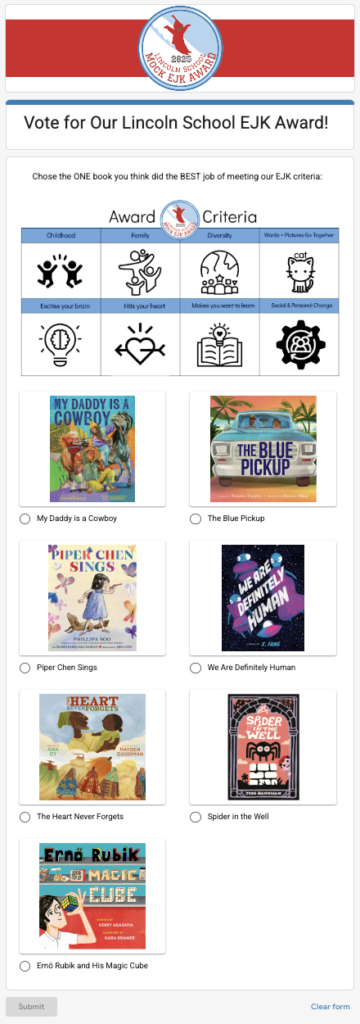
As we worked through the weeks, the kids became more and more eager to vote. I contemplated the simplest way for children to cast their votes and for me to tabulate them. I decided that a Google Form would be the easiest way to do this and imported the covers of the books as clickable options to make it visually appealing and easy to access for all learners.
Sharing the Results
To share our results in a more celebratory way, I organized a K–4 assembly in our K–8 auditorium to make it feel special. I asked the teachers to select two children from every grade level to help run the ceremony so students’ voices were centered more than my own. The complete ceremony took less than 10 minutes, and the cheers and joy that erupted when our results were announced rivaled the excitement in the video that had motivated me to take on our own school book award.
Lessons Learned
Ten books proved to be too ambitious. A snow day on the day of the week when I saw the most classes threw those classes off schedule, and while kindergarten students were very engaged in the process, their attention spans were not as long as my older students’. We ended up with seven books in our contest, and while they were all wonderful stories, one book per week would have felt less rushed and allowed us more time to dig into the stories and for me to pair individual titles with more multimodal resources such as short video clips or author interviews to enhance the overall learning experience.
Our Mock EJK Award proved to be a community-building experience that gave us common language, opportunities to grow student talk, access to rich books, and so much joy. The afternoon of the award ceremony, students asked if we were going to do it again next year each time they saw me in the hall… and I joyfully answered YES!
Download
Download a resource guide to create a mock book award experience in your school.
De León, C. (2020, January). The 10 Most Checked-Out Books in N.Y. Public Library History. The New York Times. https://www.nytimes.com/2020/01/13/books/ny-public-library-top-books-history.html
