

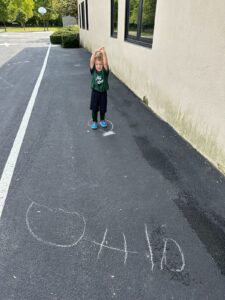
We were at a local playground in the Buckeye State last summer, and someone had left a piece of chalk lying on the blacktop. My newly turned three-year-old son took the chalk and wrote OHIO. I had no idea he could write those letters or had memorized the order of writing OHIO. How would I have ever known he could do it unless he was given the opportunity?
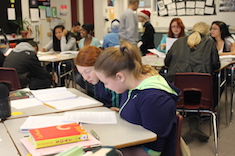
The same applies in our classrooms. If we give our students the time and space, they just might surprise us with all they are capable of doing. This is easier said than done in our fast-paced, standardized-test-driven, mandates-filled world, but with a few intentional strategies, we can slow down the pace just enough to see what our students can really do.
Closed Questioning and Open Questioning
Being intentional with the types of questions we ask students when checking in during independent work, small-group practice, or an individual conference with a student is one way to provide space for students to surprise us. If we enter a conversation with a student and already know the answer we want them to provide, we may be more prone to prompt them toward the answer we are looking for with closed questions. In contrast, if we use more open questioning that gets at the student’s own learning and understanding, we will be more responsive to the student in front of us. Using the student as our starting point helps us be more deliberate with our questioning instead of trying to get every student to respond in the exact same way. We give students the space to be the unique individuals they are.
Let’s explore what closed and open conversations might sound like in three different scenarios.
In this scenario, the teacher is having a reading conference with a student based on the student’s independent reading book. The goal is for the student to give a summary of a picture book they have read independently.

In the next scenario, the teacher is checking in with a student while the student works on a math story problem. The goal is for the student to use an efficient strategy to make sense of and solve the story problem.

In another scenario, the teacher is walking around while students are testing conductors and insulators. The goal is for each student to understand the difference between a conductor and an insulator.

Let the Kids Do the Talking
Speaking comes in many forms in the classroom: written reflection, partner share, small group, whole group, and so on. Allowing students time to formulate their thinking and share out in different ways gives them an opportunity to consolidate learning. Responding to a question or topic requires many higher-level thinking processes. One way to support all students in participating orally in the classroom is to provide sentence stems that include the type of academic vocabulary and sentence structure we expect our students to use in their responses. This gives everyone an entry point into the discussion.
When we pair the structured responses with an opportunity to practice verbally sharing with a partner or small group, students get additional repetitions so they grow more comfortable talking when called on for the whole class. Students also get a chance to hear the academic language and different responses multiple times from peers, which affords them a range of ideas and an opportunity to refine their own thinking.
We need kids to be the ones doing the talking, because if the teacher does a majority of the talking, it is likely that a significant portion of the class is not paying attention. Students eventually may learn that they do not have to listen because the teacher is going to do the talking, and they will not have to participate. Instead, we want students to have ample opportunities to respond and craft oral or written responses to the content they are learning.
Wait Time
We know the importance of wait time as an equalizer in allowing for more voices to be heard in the classroom. This is another strategy that is easier said than done, because we sometimes do not feel comfortable with silence during a discussion or share opportunity. By deliberately waiting three to five seconds after a question is asked before calling on someone or randomly selecting someone to share, we allow students to formulate responses and become more comfortable with the possibility they will be asked to share. We will also then want to wait three to five seconds after the child’s response so that students have time to process what was just said and decide whether they have something to add or contribute to the conversation.
Entry Points
Being intentional about the entry points into a lesson or learning objective can ensure that all of your students have a way to engage with the learning. We can provide additional entry points in our lessons by giving students different ways to respond or to show their learning, including visuals in the lesson delivery to support language and background knowledge development. We can also make connections between previous learning and current learning visible for students, which helps them strengthen retention of learning.
Let’s keep some of these teacher moves in mind as we provide time and space for our students to show their brilliance. When we are questioning our students to gain information about their thinking, we can use more open questions than closed questions that guide to a premade answer we are looking for. The kids need to be the ones doing much of the talking. Wait time and entry points give more access to the learning, so all students have opportunities to learn and demonstrate their thinking.
Just like at the park with my son, sometimes all it takes is a writing utensil and a blank canvas for kids to wow us.
