
Choice Lit Topic: Mentor Texts
It’s all about the right book at the right time, given to the right student or used in the right lesson . . .
Here is where we gather all those suggestions from our contributors for using mentor texts, including lesson protocols and scores of video examples.
Results

Subheading Literacy: Nothing “Sub” About It
Subheadings do a lot of work in informational text; they are crucial comprehension touchstones. Similar to chapter headings, white space, and illustrations in narrative text, subheadings alert us to pause,...
Teacher-as-Writing-Model Minilesson in Fourth Grade
Beth Lawson shares her writing process, as well as the emotions and struggles writers face, with her fourth-grade students.
Just-Right Poetry and Individualizing Instruction
One of the challenges of teaching is finding the right books and materials to address specific instructional goals. Once teachers have found the perfect book to help their students understand...
Poetry and Fluency Minilesson in Second Grade
Sean Moore uses poetry for a short minilesson on fluency, and then follows with a partner share and vocabulary discussion. The poem Sean reads with the children is The Busy...
Shared Reading to Explore Writer’s Craft in First Grade
Katie DiCesare's first graders reread a favorite text in pairs to work on noticing the details of writer's craft.
From “Show Me the Lessons” to Sustainable Planning (Part 4 of the Opinion/Argument Writing Series)
Years ago when teachers were first encouraged to use mentor texts to model for writers and weren’t sure how, I had a lot of requests for help. I heard from...
Second-Grade Writing: Adding Details and Descriptive Language
In this first video from a four-part series, Sean Moore leads a writing workshop focused on adding more details and descriptive language to writing. He begins with the classic Charlotte's...
Picture Reading in First Grade
In this read-aloud lesson from Katie DiCesare's first-grade classroom, Katie demonstrates the importance of picture reading using the picture book The Zoo by Suzy Lee. Because the students need the pictures to help understand the characters, setting and events, they are able to see how pictures help us “think in the story” and “figure out the words.”
Launching a Punctuation Study in Second Grade
Linda Karamatic begins a punctuation study with her second graders, sharing mentor texts, starting an anchor chart, and engaging students in punctuation inquiry partnerships.
Dear Eve Bunting
“I’m going to send this to Eve Bunting. Will you get me the address?” Allie shoved a book in my hands, along with a letter. Dear Eve Bunting, it began....
Field Experience: Picture Books and Older Students
The value of picture books with older students is often questioned. This field experience allows insight into the depth and power of picture books for older students. Topic: Adolescent Literacy...
Writing, Graphic Organizers, and Mentor Texts
In this video from Sean Moore's second-grade classroom, Sean demonstrates how to use a graphic organizer with his own writing as the mentor text.

Finding a Place for Graphic Novels in My Classroom
My classroom library has always been large and diverse. I want to have books for each student that they will devour. Several years ago I realized there was a hole...
The Quest for the Perfect First Read Aloud of the Year
I love summer reading. I love the freedom to read what I want, and catching up on books I’ve been meaning to read. And I love having time to browse...
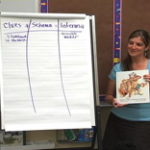
Inferring Read Aloud
In this whole-group minilesson, sixth-grade teacher Katie Doherty uses the book Wilfrid Gordon McDonald Partridge to have the students listen and chart their clues, schema and resulting inference.
Scaring Up Better Narratives Part I
Aimee Buckner leads a lesson on brainstorming topics in writer's notebooks using the mentor text Some Things Are Scary. In this first installment of a three-part series, Aimee reads the book and models her own thinking process and use of a writer's notebook.
Scaring Up Better Narratives Part 2
Aimee Buckner leads a lesson on brainstorming topics in writer's notebooks using the mentor text Some Things Are Scary. In this second installment of a three-part series, Aimee continues to confer with students and helps everyone refine potential writing topics in their notebooks.
Scaring Up Better Narratives Part 3
Aimee Buckner leads a lesson on brainstorming topics in writer's notebooks using the mentor text Some Things Are Scary. In this final installment, Aimee continues to confer with students and shares a great tip for nonfiction research.
Narrative Nonfiction in 5th Grade Part 1
In this lesson from a 5th grade classroom, Aimee Buckner guides students in a notetaking process to help understand the qualities of nonfiction narrative writing.
Listen In: XBox Game Writing
Heather confers with Cody about his gaming story. He starts off the conference by reading aloud an excerpt of his writing. Heather responds to it personally as well as compliments his growing awareness of audience. She then uses a mentor text “Shortstop from Tokyo” by Matt Christopher to show him how long and short sentences can be used to make active writing engaging. She ends with an invitation to play with this concept in his writing.
Listen In: XBox Game Writing
Cody begins the conference with, "I have a piece that I just finished," and he's off and reading. Can this be the same student I conferred with who had no...
